Ripple Global Footprint Expands, Quietly Building A Banking Empire – Here’s Why February 26 Is Important

bitcoinistPubblicato 2026-02-23Pubblicato ultima volta 2026-02-23

Introduzione

Ripple, a leading US payment company, is expanding its global footprint and building a modern digital banking empire through strategic alliances, regulatory approvals, and infrastructure development. Key acquisitions like Metaco and Hidden Road have bolstered its institutional custody, prime brokerage, and treasury infrastructure. A crucial date is February 26, when the SEC is set to announce a decision on a proposed crypto ETF, potentially providing clearer pathways for traditional investors. Meanwhile, investor interest in XRP is surging, with data showing a rapid increase in long positions, indicating growing optimism for a price rebound.

In a significant development that could shape the finance sector, Ripple, a leading American-based payment company, has disclosed its financial ambitions, which signal a growing banking powerhouse. With this move, the firm is extending its global reach in the crypto and financial landscape, reinforcing its modern-day banking infrastructure.

A Bid From Ripple To Reshape Global Banking

Ripple is taking the spotlight after an update about the firm’s latest move that underscores its financial ambitions. The company is progressively growing its global presence and establishing the foundation for what is beginning to seem like a modern digital banking empire.

By forming strategic alliances, gaining regulatory approval, and building infrastructure in important financial areas, the business is putting itself in a position to lead institutional blockchain adoption and cross-border payments. Pumpius, a crypto expert and investor, stated that Ripple is bringing together the full institutional stack in a similar pattern to how banks do it, one regulated component at a time.

The expert has also underlined the firm’s acquisitions in recent years, which tells a story. This is evidenced by the firm’s acquisition of Metaco and Hidden Road. While Metaco gave the firm institutional custody rails, Hidden Road has added prime brokerage-grade execution, financing, and access to real market plumbing. As a result of this, Ripple’s rail plugs into high-volume payment distribution.

While several prices are displayed to the public, some of them are not. However, the trajectory is clear, which is indicated by custody payments, prime brokerage, and treasury infrastructure under one roof. With the inclusion of the OCC Trust bank angle, Ripple is already moving through the United States banking pathway, generating conditional approvals observed among firms in that field.

This is considered the cheat code. Getting involved with the regulated perimeter leads to a barrier to permission, and a company becomes the system that institutions are allowed to use.

As the payment builds a banking stack, February 26 stands as a crucial date in its journey. On the day, the US Securities and Exchange Commission (SEC) is scheduled to announce its decision in a Federal Register proceeding linked to a proposed T Rowe Price crypto Exchange-Traded Fund (ETF). “That is the calendar of when traditional allocators get clearer lanes,” Pumpius added.

Long Positions In XRP Are Heating Up Once Again

With excitement surrounding several updates of Ripple, investors appear to be doubling down on XRP again. Interest in the altcoin has improved over the past few days, as long positions in the leading altcoin are reemerging at a fast rate.

Using data from Binance, the cryptocurrency exchange leader, CW has disclosed a rapid increase in XRP positions from top traders. When investors start to open longs again, it may suggest that they are positioning ahead of a potential bounce.
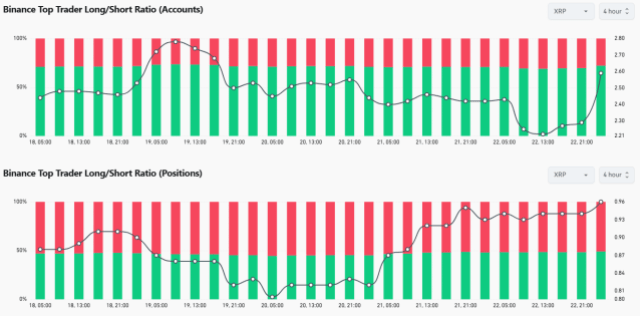
Source: Chart from CW on X

CW noted that these traders were previously positioned heavily on the short side, but the chart shows that they are now becoming neutral. As a result of the renewed conviction, the expert believes that XRP will soon regain the upper hand.

XRP trading at $1.36 on the 1D chart | Source: XRPUSDT on Tradingview.com

Domande pertinenti

QWhat is the significance of February 26th for Ripple, according to the article?

AFebruary 26th is the date the US Securities and Exchange Commission (SEC) is scheduled to announce its decision in a Federal Register proceeding linked to a proposed T Rowe Price crypto Exchange-Traded Fund (ETF), which is seen as a crucial moment for traditional allocators to get clearer regulatory lanes.

QWhich two key companies has Ripple acquired to build its institutional infrastructure?

ARipple has acquired Metaco, which provided institutional custody rails, and Hidden Road, which added prime brokerage-grade execution, financing, and access to real market plumbing.

QHow are top traders on Binance positioning themselves regarding XRP, as reported in the article?

AData from Binance shows a rapid increase in long positions for XRP from top traders, indicating they are positioning ahead of a potential price bounce after previously being heavily positioned on the short side.

QWhat strategy is Ripple using to build a modern digital banking empire, as described by the expert Pumpius?

ARipple is building its empire by forming strategic alliances, gaining regulatory approvals, and building infrastructure in key financial areas, bringing together the full institutional stack one regulated component at a time, similar to how traditional banks operate.

QWhat specific advantage does the article say Ripple gains by operating within the regulated perimeter?

AOperating within the regulated perimeter creates a barrier to permission and allows the company to become the system that institutions are officially allowed to use, which is described as 'the cheat code' for success.

Letture associate

Jane Street's Three Sins: Insider Trading, Index Manipulation, and the Bitcoin 'Morning Massacre'

Jane Street, a highly profitable quantitative trading firm, faces serious allegations across multiple continents. In the U.S., Terraform Labs’ bankruptcy trustee has sued Jane Street, accusing it of insider trading related to the May 2022 collapse of Terra Luna. The suit claims Jane Street withdrew $85 million from a liquidity pool just minutes after Terraform secretly removed $150 million, allegedly using non-public information from a former intern. The action allegedly helped trigger a $40 billion crash. Simultaneously, in India, the Securities and Exchange Board (SEBI) has accused Jane Street of manipulating the Bank Nifty index through a “pump-and-dump” scheme over 18 expiration dates, resulting in alleged illegal profits of ~$580 million. Jane Street has been barred from Indian markets and is appealing. Additionally, Bitcoin traders had observed a pattern of sharp sell-offs at 10 AM ET—dubbed the "10 AM Crashes"—coinciding with U.S. market open, which many attributed to Jane Street’s trading activity. Notably, Jane Street is an authorized participant of BlackRock’s IBIT Bitcoin ETF, holding significant shares. After the Terra lawsuit was filed, the predictable sell-offs stopped, and Bitcoin saw a notable price rebound. The broader implication is the risk of market manipulation by privileged intermediaries within ETF structures—a problem Bitcoin was designed to overcome. If Jane Street halts its alleged manipulative strategies due to legal pressure, a major selling pressure on Bitcoin may be removed.

marsbit13 min fa

Jane Street's Three Sins: Insider Trading, Index Manipulation, and the Bitcoin 'Morning Massacre'

marsbit13 min fa

Stock Price Surges Over 35%! Circle's Earnings Report Exceeds Expectations: USDC Circulation Soars 72%

Circle (CRCL) reported strong Q4 and full-year 2025 financial results, with total revenue and reserve income reaching $770 million in Q4, up 77% year-over-year, exceeding expectations. This drove a 35% surge in its stock price. Key highlights include a 72% YoY increase in USDC circulation to $75.3 billion and a 247% rise in on-chain transaction volume to $11.9 trillion in Q4. Reserve income remained the core revenue driver at $733 million, while non-interest income reached $37 million. For the full year, total revenue grew 64% to $2.7 billion. Although the company reported a net loss of $70 million due to a one-time $424 million stock-based compensation expense from its IPO, adjusted EBITDA doubled to $582 million, indicating profitable core operations. Strategic developments include the stable testnet performance of its Arc blockchain, expansion of the Circle Payments Network with 55 financial institutions onboarded, and a key partnership with Polymarket to use native USDC. Regulatory progress includes conditional approval for a national trust bank. Looking ahead, Circle targets a 40% compound annual growth rate for USDC circulation. CEO Jeremy Allaire emphasized AI-driven payment demand, with 99% of agent-based payments currently using USDC. Despite challenges like declining yields and new competitors like USAT, Circle continues to execute its strategy as a growing internet financial infrastructure provider.

marsbit52 min fa

Stock Price Surges Over 35%! Circle's Earnings Report Exceeds Expectations: USDC Circulation Soars 72%

marsbit52 min fa

Trading

Spot
Futures
活动图片